01
Harvest
At the hospital.
Tissue is collected through a minimally invasive liposuction procedure.

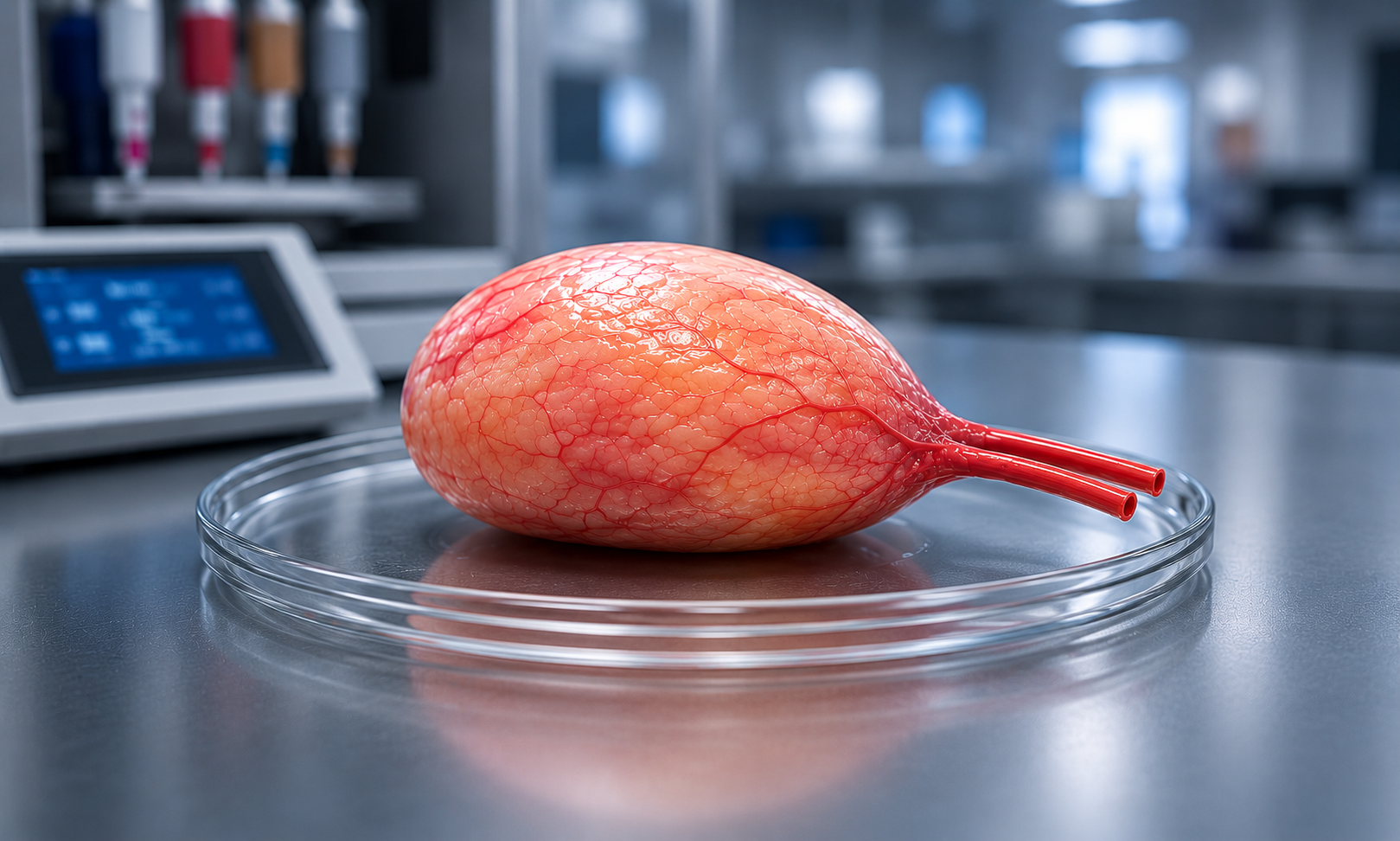
Patient-derived, vascularized tissue implants for soft tissue reconstruction and aesthetic applications, starting with breast reconstruction. A living tissue implant, made from your own cells and connected to your body's blood supply, designed to last.
Many will lose tissue to surgery. For many, the available options to rebuild what was lost do not feel acceptable.
Of women diagnosed with breast cancer will undergo mastectomy or lumpectomy.
Decline reconstruction entirely.
Re-operation rate for implants within 7 years.

The cost of inaction
Reconstruction is covered by federal law. Yet many women still walk away. Implants can require additional procedures over time and carry ongoing risks. Flap procedures are complex and involve surgery at multiple sites. For many patients, reconstruction becomes an ongoing burden rather than a step toward recovery.
Two primary approaches exist, each with meaningful tradeoffs.
Foreign materials placed in the body. Often require additional procedures over time. Associated with risks such as rupture, capsular contracture, and recall.
Transfers tissue from another part of the body. Complex procedures with recovery at both the breast and donor site. Not suitable or desirable for many patients.
Women don't need another compromise.They need a better option.
Tissue is collected through a minimally invasive liposuction procedure.
Your cells are used to create a vascularized implant using proprietary 3D bioprinting technology developed at the Wyss Institute at Harvard.
The implant is placed using microsurgical techniques and connected to blood vessels, enabling integration as living tissue.
Your cells. A personalized implant. No large donor-site surgery. Built to last.






Patients, surgeons, and hospitals all benefit from the shift to living tissue.
Survivorship should not come with lifelong compromise.
Many women describe reconstruction as an ongoing burden rather than closure. Repeated surgeries. Anxiety about implant safety. Outcomes that do not feel natural. ReConstruct Bio is focused on changing that by creating a solution that works with the body and supports long-term quality of life.