01 Harvest.
Tissue is collected through a minimally invasive liposuction procedure at the patient's hospital. This is a standard approach used in clinical practice.

Why we exist
ReConstruct Bio was founded to solve a problem that has persisted for decades. Women who survive breast cancer are left with reconstruction options that are either synthetic, invasive, or both. Our technology, developed at the Wyss Institute at Harvard, forms a patient's own vascularized tissue into an implantable living construct. A living implant, made from the patient, for the patient.
Three steps, refined in the lab, designed to fit existing surgical practice.
Tissue is collected through a minimally invasive liposuction procedure at the patient's hospital. This is a standard approach used in clinical practice.
At the ReConstruct Bio facility, the harvested tissue is formed into a construct and vascularized using SWIFT, a proprietary 3D bioprinting technology developed at the Wyss Institute at Harvard. Over several days, the construct is perfused and matured into a vascularized implant with functional channels.
The BioImplant is surgically placed using established microsurgical techniques, where it is connected to blood vessels. Once in place, the tissue integrates with the body and remodels over time.
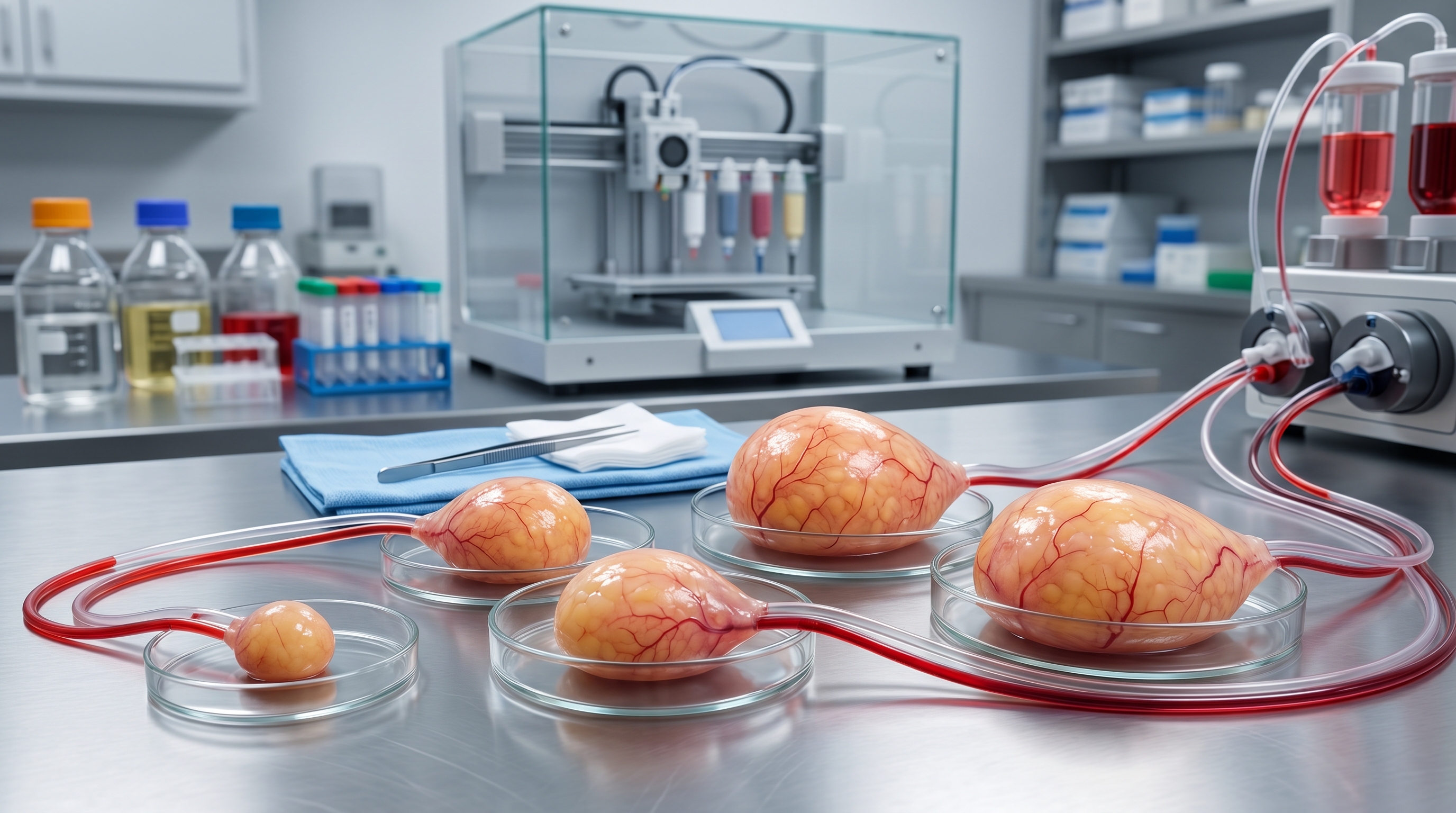
SWIFT is the foundational vascularization technology behind the BioImplant. Engineered tissues require perfusable networks to support viability. SWIFT enables the formation of these networks by creating channels within a dense, living cellular matrix that can be perfused.
Cell aggregates are compacted into a dense, living matrix approaching the cellular density of native tissue.
A fugitive ink is written through the matrix, defining a vascular network without damaging surrounding cells.
The ink is removed, leaving behind open channels that can be perfused to support tissue viability.
Technology originated at the Wyss Institute at Harvard.
Demonstrated in vivo. Layered patent coverage across the United States, Europe, China, and Australia.
Regenerative medicine, biofabrication, biotech leadership, and clinical reconstruction.

CEO and Co-Founder
Regenerative medicine leader with 15+ years in translational research across industry and academia. Led development of vascularized tissue platforms at the Wyss Institute from concept to in vivo validation. Trained at Harvard, MIT, BU, and the Technion.

Executive Chairman
Biotech and tech executive with multiple company builds and exits. Co-founder and former CEO of TetraGenetics, acquired by AbCellera. Trained at Stanford and Cornell.

Lead Scientist
Biofabrication and 3D bioprinting expert with a PhD from Notre Dame. Leads development of vascularized tissue implants using patient-derived cells, from design through preclinical validation.

Clinical Founder (BIDMC)
Harvard plastic surgeon specializing in microsurgery and breast reconstruction. Director of Aesthetic Surgery at BIDMC and Associate Professor of Surgery at Harvard Medical School. Leads clinical strategy and surgical integration of the BioImplant.
Experts in biofabrication, vascular biology, and clinical reconstruction with deep academic and translational experience.

Harvard and Wyss Professor
Pioneer in biofabrication and 3D printing of functional tissues. Founder of multiple companies translating materials science into clinical applications.

BU and Wyss Professor
Leader in vascular biology and tissue engineering. Expert in cellular microenvironments and translation of engineered tissues into clinical systems.

Head of Innovation, TreeFrog Therapeutics
Biofabrication scientist and co-inventor of the SWIFT vascularization platform. Expert in 3D bioprinting of perfusable tissue constructs.

Stanford Plastic Surgeon
Stanford plastic surgeon specializing in microsurgery and complex reconstruction. Advises on clinical translation and surgical integration.